



PACER Test: Audio, Scores by Age and Beep Test Guide (2026)
How the PACER test works, FitnessGram laps by age and sex, how it differs from the UK bleep test and the Léger protocol, and a free 20 m shuttle run audio with level speeds and a VO2max table.
Reading time: about 8 min

| QUICK ANSWER |
|---|
| The PACER test (Progressive Aerobic Cardiovascular Endurance Run) is a 20-meter shuttle run, also called the beep test, in which you run between two lines in time with beeps that get faster every minute until you can no longer keep up. FitnessGram, the US school fitness program from the Cooper Institute, uses it to measure aerobic capacity, and your score is the number of laps you complete. This guide gives the official FitnessGram minimum laps by age and sex, explains how the FitnessGram PACER, the UK bleep test and the Léger protocol differ, and includes a free Léger 20 m audio, the speed-by-level table and a VO2max estimate. |
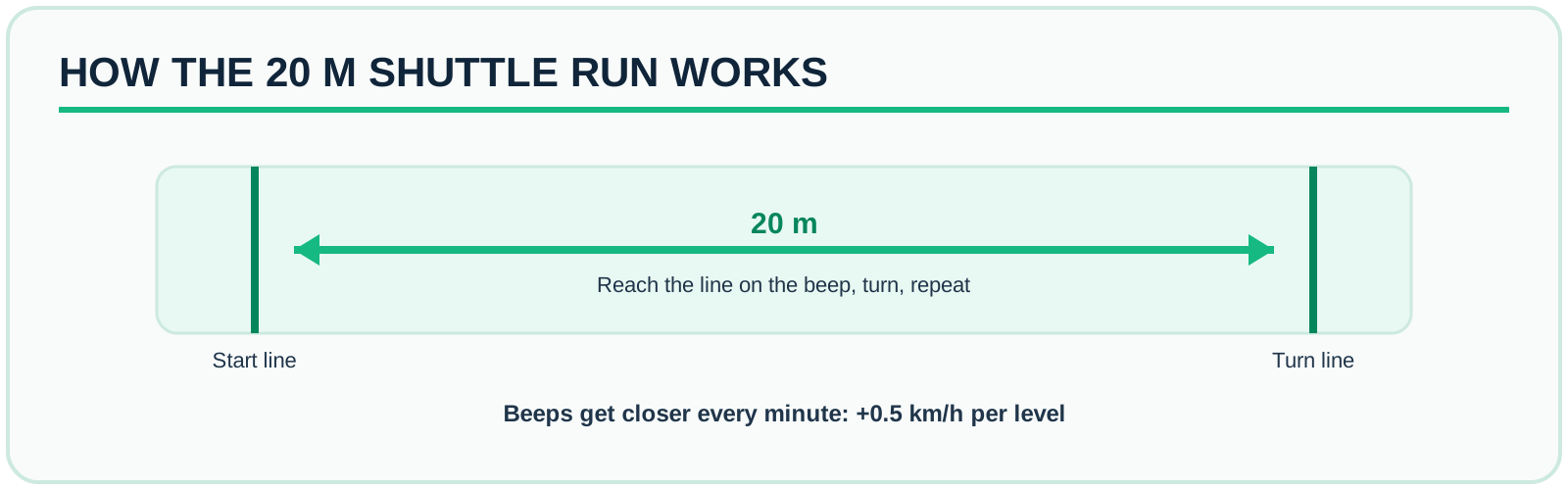
The PACER test is a 20-meter shuttle run: you run between two lines in time with a recording whose beeps come faster every minute, and your score is how many laps you complete before the second time you fail to reach the line by the beep (the FitnessGram rule; the misses do not need to be consecutive). It is the same idea as the beep test used in sport and the military, which is why people search for both names. The audio further down the page follows the original Léger 20 m protocol, so read the section on how it differs from the official FitnessGram recording before you use it for anything graded.
FitConnect Pro protocol · Léger 20 m
Shuttle run audio: 8.5 km/h + 0.5 km/h per minute
Original audio made by FitConnect Pro: a 5-second countdown and 10 one-minute levels. Set your lines exactly 20 meters apart. This is the Léger protocol, not the official FitnessGram PACER recording; for school testing or an exam, use the official audio.
Download MP3 audioWhat is the PACER test?
PACER stands for Progressive Aerobic Cardiovascular Endurance Run. It is one of the aerobic capacity options in FitnessGram, the fitness assessment developed by The Cooper Institute and widely used in US physical education. It is a version of the 20 m multistage shuttle run that Luc Léger and colleagues published in 1988, itself a refinement of the 1982 test by Léger and Lambert. The test estimates aerobic capacity (VO2max) from how long you can keep up with a pace that rises every level.
PACER test vs beep test vs bleep test vs Léger
These names describe the same family of tests, but the recordings are not identical, so scores do not transfer one-to-one.
| Name | Where used | Start speed | How it increases |
|---|---|---|---|
| Léger 20 m (Léger et al., 1988) | Research, sport, our audio | 8.5 km/h | +0.5 km/h every 1-minute level |
| Multistage fitness test / bleep test (Ramsbottom et al., 1988) | UK sport, police and armed forces selection | 8.5 km/h | +0.5 km/h per level; scored as level.shuttle |
| FitnessGram PACER | US schools | about 8.0 km/h (9 s for the first lap) | 9.0 km/h at level 2, then +0.5 km/h per level; scored in laps |
The FitnessGram first-level timing comes from the official recording as analyzed by Top End Sports; the Cooper Institute does not publish a per-level speed table on its public pages, so treat 8.0 km/h as a well-supported reading of the recording rather than a quoted official figure. The original UK paper is Ramsbottom et al. (1988).
Which audio should you use?
Use the audio your assessor names. For a US school FitnessGram test that means the official FitnessGram PACER recording. For a UK fitness test it means the recording the employer or club specifies. The audio on this page is original FitConnect Pro material that follows the Léger protocol: a 5-second countdown, then 10 levels of exactly one minute starting at 8.5 km/h. It is useful for practice, for coaches who want a consistent standard, and for tracking one athlete over time. It is not the official FitnessGram audio, and laps counted on it should not be compared with FitnessGram standards.
How to set up and run the 20 m shuttle run
- Mark two lines exactly 20 meters apart on a flat, non-slip surface, with at least a meter of clear space behind each line.
- Warm up with easy jogging, dynamic mobility and a few practice turns.
- Start the audio and begin behind one line. Run to the other line and reach it before the beep.
- Turn, run back, and keep alternating. When the recording signals a new level, the beeps come slightly closer together.
- If you reach a line after the beep, you are given a chance to catch up. In FitnessGram the test ends the second time you fail to reach the line by the beep, even if the two misses are not consecutive, or when you choose to stop.
- Record the final result: laps for FitnessGram, or level and shuttle for the bleep test.
FitnessGram also allows a 15-meter version for younger children or small spaces. Its results are not interchangeable with the 20 m test, so always note which distance you used.
Level and speed table (Léger 20 m)
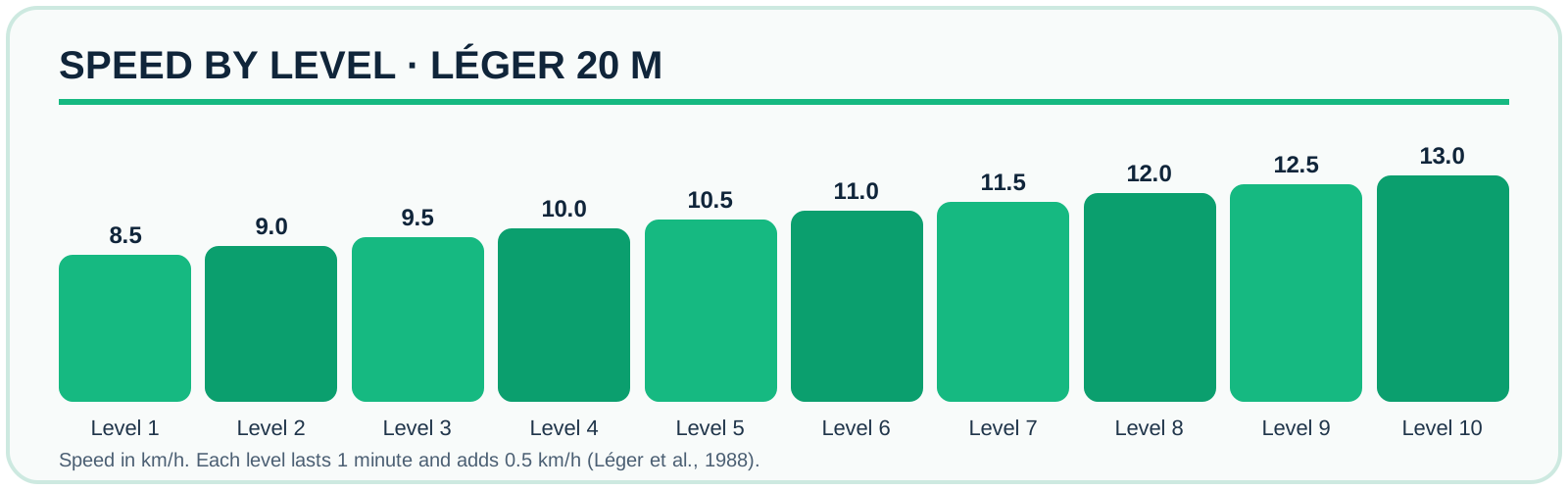
This table matches the audio on this page. Time per 20 m lap is 72 divided by the speed in km/h. The lap counts are measured on our recording, which changes level every 60 seconds, so a partial lap at the end of a level is not counted.
| Level | Speed | Time per 20 m | Laps in this audio | Total distance |
|---|---|---|---|---|
| 1 | 8.5 km/h (5.3 mph) | 8.47 s | 7 | 140 m |
| 2 | 9.0 km/h (5.6 mph) | 8.00 s | 7 | 280 m |
| 3 | 9.5 km/h (5.9 mph) | 7.58 s | 7 | 420 m |
| 4 | 10.0 km/h (6.2 mph) | 7.20 s | 8 | 580 m |
| 5 | 10.5 km/h (6.5 mph) | 6.86 s | 8 | 740 m |
| 6 | 11.0 km/h (6.8 mph) | 6.55 s | 9 | 920 m |
| 7 | 11.5 km/h (7.1 mph) | 6.26 s | 9 | 1,100 m |
| 8 | 12.0 km/h (7.5 mph) | 6.00 s | 10 | 1,300 m |
| 9 | 12.5 km/h (7.8 mph) | 5.76 s | 10 | 1,500 m |
| 10 | 13.0 km/h (8.1 mph) | 5.54 s | 10 | 1,700 m |
PACER test scores: what is a good score?
FitnessGram does not use a single pass mark. Since 2013-14 the Healthy Fitness Zone (HFZ) for aerobic capacity is based on sex, age and laps only. The Cooper Institute table, as published by the California Department of Education (December 2017), gives the minimum number of 20 m laps to reach the zone:
| Age | Girls: minimum laps | Boys: minimum laps |
|---|---|---|
| 10 | 17 | 17 |
| 11 | 20 | 20 |
| 12 | 23 | 23 |
| 13 | 25 | 29 |
| 14 | 27 | 36 |
| 15 | 30 | 42 |
| 16 | 32 | 47 |
| 17 | 35 | 50 |
| Over 17 | 38 | 54 |
Source: FitnessGram PACER Look-Up and Goal Setting Table (Cooper Institute). These are FitnessGram laps, not laps on the audio on this page. Check your district's current FitnessGram standards before reporting results, since the program updates them from time to time.
For adults, FitnessGram laps are not the usual yardstick. Sport, police and military selection tests set their own required level on the bleep test, so look up the standard your employer or team publishes and use their recording.
Estimating VO2max from a shuttle run
Léger and colleagues (1988) predicted VO2max (ml/kg/min) from the speed of the last completed level (X, in km/h, where X = 8 + 0.5 × level) and age (A, in years): VO2max = 31.025 + 3.238·X − 3.248·A + 0.1536·A·X. The equation was derived from schoolchildren aged 8 to 19. For adults the authors indicated it can be used with A = 18, which simplifies to roughly VO2max = −27.4 + 6.0·X.
| Last level | Speed (X) | Estimated VO2max (A = 18) |
|---|---|---|
| 4 | 10.0 km/h | 32.6 ml/kg/min |
| 5 | 10.5 km/h | 35.6 ml/kg/min |
| 6 | 11.0 km/h | 38.6 ml/kg/min |
| 7 | 11.5 km/h | 41.6 ml/kg/min |
| 8 | 12.0 km/h | 44.6 ml/kg/min |
| 9 | 12.5 km/h | 47.6 ml/kg/min |
| 10 | 13.0 km/h | 50.6 ml/kg/min |
This is an estimate with a margin of error, and it applies to the Léger protocol (8.5 km/h start, one-minute levels), not to laps on a FitnessGram recording. Do not use it as a diagnosis. The UK paper by Ramsbottom and colleagues reports its own equation, derived from 74 volunteers with directly measured VO2max, so do not mix the two sets of numbers.
Tips to improve your PACER test score
- Practice the turn: plant a foot on or just past the line and push off without braking early. Running several meters past the line adds distance but no score.
- Do not sprint to the line and wait. Arrive on the beep, then turn.
- Build an aerobic base with continuous running and intervals near the speeds of the later levels, with planned recovery.
- Train changes of direction at submaximal effort before attempting a full test.
- Avoid full maximal tests more than every few weeks; use shorter blocks of levels in between.
If your target is a continuous-run benchmark instead, see the Cooper test guide. Both tests estimate aerobic fitness, but the Cooper test is a self-paced 12-minute run while the shuttle run is paced by the audio and includes constant turns.
Safety and when to stop
The test is maximal, so check beforehand that the person can exercise at high intensity and has no symptoms or injury that rules it out. Screening guidance is set out in the American College of Sports Medicine's guidelines for exercise testing and prescription. Stop immediately for chest pain, dizziness, loss of coordination, unusual shortness of breath or sharp musculoskeletal pain, keep the floor clear and dry, and have an emergency plan for the venue.
Common mistakes
- Measuring roughly 20 meters instead of exactly 20.
- Using an unidentified recording, or comparing laps from one recording to a table made for another.
- Starting too fast and fading before the later levels.
- Not agreeing the stopping rule (FitnessGram: the second miss, not necessarily consecutive) before the test.
- Recording only a level and losing the shuttle or lap count.
- Applying the VO2max equation to a different protocol or population.
How coaches track the PACER test
A shuttle run is most useful when you repeat it under the same conditions: same recording, same surface, same warm-up and time of day. Log laps or level, the recording used and how the athlete felt, then compare across blocks. If you run an online personal training business or coach teams and clients in person, keeping those results next to the training plan makes it easy to see whether the program is working.
PACER test FAQ
What is the PACER test?
The PACER (Progressive Aerobic Cardiovascular Endurance Run) is a multistage 20-meter shuttle run used in FitnessGram to assess aerobic capacity. You run back and forth between two lines, reaching each one before the beep, and the beeps speed up each level. It is an adaptation of the 20 m shuttle run test published by Luc Léger.
Is the PACER test hard?
It is designed to be maximal: the early levels feel easy and the last ones are very hard, because the test only ends when you cannot keep pace. How hard it feels depends on your age, fitness and how well you practiced the turns. Pacing yourself and not sprinting to the lines early makes a large difference.
What is a good PACER test score?
For students, a good score is at or above the FitnessGram Healthy Fitness Zone minimum for your age and sex. For example, that is 23 laps for a 12-year-old of either sex, and 54 laps for a boy or 38 laps for a girl over 17. Adults are usually compared with the level reached on the beep test rather than FitnessGram laps.
How many laps is the PACER test?
There is no fixed number: you keep running until you miss the beep for the second time. The FitnessGram target depends on age and sex, from 17 laps at age 10 to 54 laps for boys and 38 for girls over 17.
How long is the PACER test?
A typical run lasts from a couple of minutes for a low score to about ten minutes or more for a high one. The test keeps going until you can no longer keep up, so duration depends on your fitness.
Is the beep test the same as the PACER test?
They are close relatives. Both are 20 m multistage shuttle runs, but the recordings differ: the UK bleep test (Ramsbottom et al., 1988) starts at 8.5 km/h, while FitnessGram's PACER uses its own recording and lap counts per level. Scores from different recordings are not interchangeable.
Can I use this audio for my school fitness test?
No. The audio on this page follows the Léger 20 m protocol (8.5 km/h, +0.5 km/h every minute). It is not the official FitnessGram recording. For graded school tests, an exam or a job selection, use the official audio your organization specifies.
Conclusion
The PACER test, beep test and Léger run share the same logic but not the same recording, so identify the protocol first, measure 20 meters accurately and record the result in the units that protocol uses. If you coach several people, create a free FitConnect Pro account to keep their tests, plans and progress in one history.
Sources and editorial note
- Léger LA, Mercier D, Gadoury C, Lambert J. The multistage 20 metre shuttle run test for aerobic fitness. Journal of Sports Sciences, 1988.
- Léger LA, Lambert J. A maximal multistage 20-m shuttle run test to predict VO2max. Eur J Appl Physiol, 1982.
- Ramsbottom R, Brewer J, Williams C. A progressive shuttle run test to estimate maximal oxygen uptake. British Journal of Sports Medicine, 1988.
- FitnessGram PACER Look-Up and Goal Setting Table, The Cooper Institute / California Department of Education, December 2017.
- FitnessGram: the PACER test.
- Top End Sports: PACER test levels and speeds (secondary source for the FitnessGram first-level timing).
- ACSM's Guidelines for Exercise Testing and Prescription.
Informational content for exercise professionals, not medical advice. A maximal test should be adapted to the person and setting. The audio on this page is original FitConnect Pro material and not the official FitnessGram recording.