



Cooper Test: How It Works, Norms Chart and VO2max Formula (2026)
Cooper test guide: the 12-minute protocol, distance in meters and miles, VO2max formula with an example, norms chart by age and sex, the 1.5-mile version and common mistakes.
Reading time: about 12 min

| QUICK SUMMARY |
|---|
| The Cooper test is a 12-minute run: you cover as much distance as you can on a flat, measured surface and record it. Distance converts to an estimated VO2max with the Cooper formula, (meters - 504.9) / 44.73, so 2,520 m (1.57 miles) is about 45.1 ml/kg/min. Below you get the protocol, norms by age and sex in meters and miles, the 1.5-mile variant and the mistakes that skew the result. |
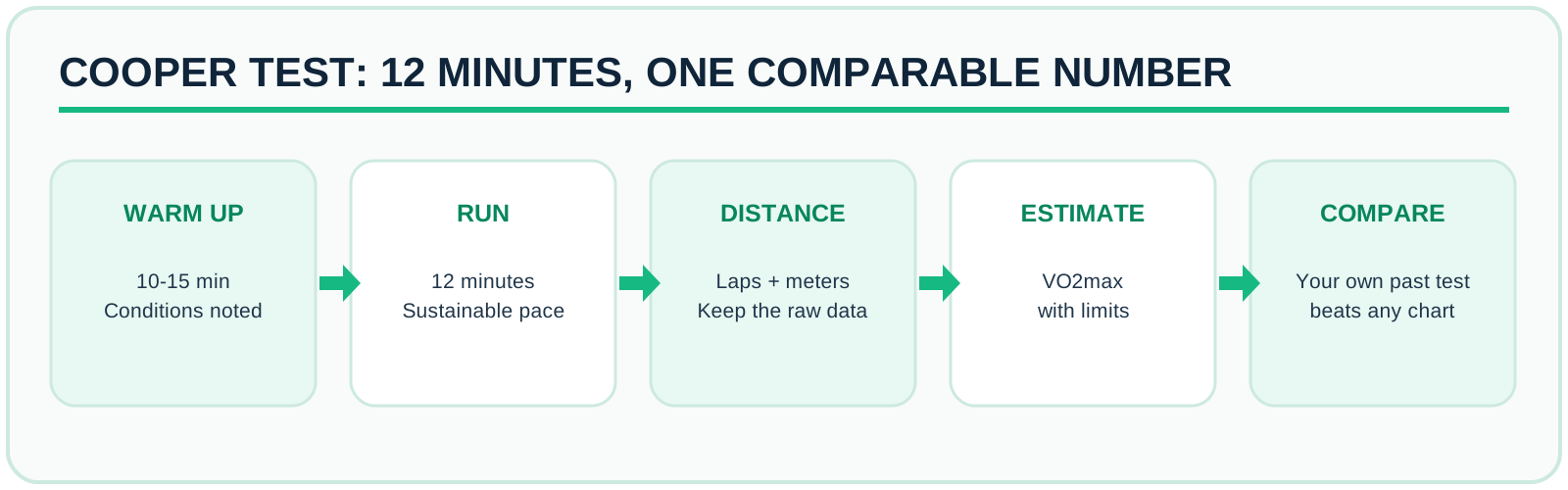
The Cooper test (the Cooper 12-minute run test) is a field test of aerobic endurance. You run, or run and walk, for exactly 12 minutes and note the distance. That distance is compared with an age and sex chart or converted into an estimated VO2max. There are no beeps: that is the PACER test.
This page covers the protocol, norms and formula. If you only need the number, use the Cooper test calculator: enter your distance in meters or miles and get an estimated VO2max.
What the Cooper test is and what it measures
The test measures how far you can sustain a continuous run in 12 minutes. Distance reflects aerobic capacity, but also running economy, pacing skill, motivation, surface and weather.
Dr. Kenneth H. Cooper published it in 1968 as a field alternative to laboratory exercise tests. In the original study, 115 U.S. Air Force officers and airmen ran for 12 minutes and later took a maximal treadmill test; distance and maximal oxygen uptake correlated at 0.897 (Cooper Institute; Cooper, JAMA 1968). That is why it estimates VO2max rather than measures it: the gold standard is still a lab test with gas analysis.
It is useful for three things: seeing how well you sustain a hard run, comparing yourself with an age and sex chart, and above all tracking your own progress by repeating the same protocol.
Who should and should not take it
It is an all-out effort. It suits apparently healthy, active adults with basic running experience, and it is common in school PE, sports teams and fitness-test preparation.
It is not a good first choice for very sedentary people, anyone with joint pain when running, cardiovascular symptoms, an acute illness or an injury. The Cooper Institute suggests the one-mile Rockport walk test in those cases. Review your history, symptoms and medication first, and stop at chest pain, dizziness, loss of coordination or breathlessness out of proportion to effort. If in doubt, check with a healthcare professional before testing.
What you need
- A 400-meter track (one lap = 400 m = about 437 yards) or a flat, accurately measured loop.
- A visible, reliable stopwatch. No audio or beeps needed.
- Cones or marks every 50 or 100 meters to measure the last partial lap.
- A lap counter or score sheet; with a group, one helper per runner.
- Water and a safe space to walk afterwards.
Some older U.S. tracks are 440 yards (quarter mile), where one lap is 402.3 m, not 400 m. Check the track before you count laps. On a treadmill you can track personal progress, but the score does not compare directly with a track.
How to do the Cooper test step by step
1. Set up the conditions
Pick a time with mild temperature and little wind, avoid a hard session the day before and arrive hydrated. Note the place, surface, shoes and weather so you can interpret future differences.
2. Warm up for 10 to 15 minutes
Dynamic mobility, easy running and two or three short strides. The Cooper Institute asks for at least five minutes; trained runners usually benefit from more.
3. Start on a clear signal
Start the stopwatch at the line. With several runners, assign lanes or a lap counter per person.
4. Cover as much distance as you can sustain for 12 minutes
Hold a hard but controlled pace. Walking is allowed if your protocol does not forbid it. The aim is the biggest total distance, not winning the first minute.
5. Stop on the whistle and mark your spot
At 12 minutes keep walking to recover, but mark exactly where time ran out. Add full laps and the extra meters.
6. Cool down and log it
Walk for five to ten minutes. Record distance, perceived effort, lap splits and any incident. If there was pain, a timing error or an interruption, flag the test as not comparable.
How to pace a 12-minute run
The most common mistake is starting at a speed you cannot hold. A practical guide:
- Minutes 0-3: settle into a firm pace with no opening sprint.
- Minutes 3-8: hold the speed and control your breathing.
- Minutes 8-10: judge whether you have room to build.
- Minutes 10-12: lift gradually with whatever effort is left.
Lap splits show whether pacing was even. A much faster first lap usually signals poor pacing, not better fitness.
How to calculate your distance
| Total distance = full laps x 400 m + meters on the last lap |
Example: 6 full laps plus 120 m is 6 x 400 + 120 = 2,520 meters, which is about 1.57 miles or 2,756 yards. With many runners, use individual sheets or counters instead of memory.
Cooper test VO2max formula with a worked example
With distance in meters, the equation derived from Cooper's work is:
| Estimated VO2max (ml/kg/min) = (distance in meters - 504.9) / 44.73 |
Using the 2,520 m example: (2,520 - 504.9) / 44.73 = 2,015.1 / 44.73, about 45.1 ml/kg/min. If the clock stops at 2,800 m (1.74 miles), the result is 51.3.
| 12-minute distance | In miles | Estimated VO2max |
|---|---|---|
| 1,600 m | 0.99 mi | 24.5 ml/kg/min |
| 2,000 m | 1.24 mi | 33.4 ml/kg/min |
| 2,400 m | 1.49 mi | 42.4 ml/kg/min |
| 2,800 m | 1.74 mi | 51.3 ml/kg/min |
| 3,200 m | 1.99 mi | 60.3 ml/kg/min |
This table is pure math: it does not classify health. If you ran in miles, multiply by 1,609.34 to get meters first, or skip the arithmetic with the Cooper test calculator.
Cooper 1.5-mile run: the version used in many US programs
Instead of fixing the time, the 1.5-mile (2,414 m) version fixes the distance and times you. The Cooper Institute equation is VO2max = 483 / time in minutes + 3.5 (Cooper Institute). It is common in military, police and school testing, but each agency sets its own pass marks, so always read the current standard that applies to you.
| 1.5-mile time | Estimated VO2max |
|---|---|
| 10:00 | 51.8 ml/kg/min |
| 12:00 | 43.8 ml/kg/min |
| 14:00 | 38.0 ml/kg/min |
| 15:00 | 35.7 ml/kg/min |
Both versions estimate the same thing from different effort designs, so do not mix them when you compare progress. Pick one and stick to it.
Cooper test norms chart by age and sex
These charts reproduce the published bands based on Cooper (1968), in meters covered in 12 minutes, with miles added for U.S. readers (compiled by Topend Sports). They are population references, not the minimum mark for any job or exam.
Men
| Age | Excellent | Above average | Average | Below average | Poor |
|---|---|---|---|---|---|
| 20-29 | > 2,800 m (1.74 mi) | 2,400-2,800 m (1.49-1.74 mi) | 2,200-2,399 m (1.37-1.49 mi) | 1,600-2,199 m (0.99-1.37 mi) | < 1,600 m (0.99 mi) |
| 30-39 | > 2,700 m (1.68 mi) | 2,300-2,700 m (1.43-1.68 mi) | 1,900-2,299 m (1.18-1.43 mi) | 1,500-1,899 m (0.93-1.18 mi) | < 1,500 m (0.93 mi) |
| 40-49 | > 2,500 m (1.55 mi) | 2,100-2,500 m (1.30-1.55 mi) | 1,700-2,099 m (1.06-1.30 mi) | 1,400-1,699 m (0.87-1.06 mi) | < 1,400 m (0.87 mi) |
| 50+ | > 2,400 m (1.49 mi) | 2,000-2,400 m (1.24-1.49 mi) | 1,600-1,999 m (0.99-1.24 mi) | 1,300-1,599 m (0.81-0.99 mi) | < 1,300 m (0.81 mi) |
Women
| Age | Excellent | Above average | Average | Below average | Poor |
|---|---|---|---|---|---|
| 20-29 | > 2,700 m (1.68 mi) | 2,200-2,700 m (1.37-1.68 mi) | 1,800-2,199 m (1.12-1.37 mi) | 1,500-1,799 m (0.93-1.12 mi) | < 1,500 m (0.93 mi) |
| 30-39 | > 2,500 m (1.55 mi) | 2,000-2,500 m (1.24-1.55 mi) | 1,700-1,999 m (1.06-1.24 mi) | 1,400-1,699 m (0.87-1.06 mi) | < 1,400 m (0.87 mi) |
| 40-49 | > 2,300 m (1.43 mi) | 1,900-2,300 m (1.18-1.43 mi) | 1,500-1,899 m (0.93-1.18 mi) | 1,200-1,499 m (0.75-0.93 mi) | < 1,200 m (0.75 mi) |
| 50+ | > 2,200 m (1.37 mi) | 1,700-2,200 m (1.06-1.37 mi) | 1,400-1,699 m (0.87-1.06 mi) | 1,100-1,399 m (0.68-0.87 mi) | < 1,100 m (0.68 mi) |
How to read them: a 35-year-old woman who runs 2,200 m (1.37 miles) lands in the above-average band (2,000-2,500 m). Other sources publish slightly different cutoffs, especially for women, and the 50-plus groups are wide. The original sample was military, so treat the band as guidance and give more weight to your own trend.
How to interpret your result
The most reliable comparison is with your own earlier tests under similar conditions. A longer distance can mean better fitness, but check pacing, familiarity and weather too. Always keep the raw distance so you can reinterpret it if the reference chart changes.
Cooper test vs PACER test and other fitness tests
Searchers often confuse the Cooper test with beep tests. The Cooper test has no beeps or audio; the beeps belong to the PACER (20-meter shuttle run).
| Test | Effort | Main advantage | Main limitation |
|---|---|---|---|
| Cooper 12-minute run | Continuous maximal, 12 min | Simple and running-specific | Needs a track and pacing skill |
| Cooper 1.5-mile run | Continuous maximal, fixed distance | Common in many US standards | Time depends on pacing and conditions |
| PACER | Progressive maximal, 20 m shuttles | Easy for groups in little space | Adds turns and depends on audio |
In practice, Cooper shows how far you go at a free pace, while the PACER shows when you stop keeping up with an imposed pace. Read the full PACER test guide for the shuttle format; the tests are not interchangeable, so choose by goal and by whether you can repeat the protocol.
How often to repeat it
Every six to twelve weeks is usually enough to see adaptation without turning the test into a frequent all-out session. If conditions are very different (wind, night, fatigue), file it as a training run, not an equivalent re-test.
Common mistakes
- Skipping the warm-up or starting too fast.
- Miscounting laps or rounding the last fraction without marking it.
- Comparing treadmill and track, or loops with different turns and hills.
- Applying a chart without knowing its age, sex or reference population.
- Turning the estimated VO2max into a diagnosis.
- Repeating the test fatigued and concluding fitness dropped.
- Entering miles where meters are expected (or the reverse) in a calculator.
Logging the Cooper test in client tracking
For coaches: store the distance, date, place and conditions in the client's record, not just the category. Repeat every 6-12 weeks and compare only equivalent tests. In FitConnect Pro you can keep these data next to the plan and check-ins; the guide to online personal training shows how assessment, planning and review fit together.
Cooper test FAQ
What is the Cooper test?
The Cooper test is a 12-minute run designed by Dr. Kenneth Cooper in 1968. You run as far as you can in 12 minutes on a flat, measured surface, then compare the distance with an age and sex chart or convert it into an estimated VO2max.
How do you calculate VO2max from the Cooper test?
Use VO2max (ml/kg/min) = (distance in meters - 504.9) / 44.73. For 2,520 m (about 1.57 miles) that gives roughly 45.1. If you ran in miles, convert first: miles x 1,609.34 = meters. The free calculator on this site does it for you.
What is a good Cooper test score?
It depends on age and sex. A man aged 20-29 who covers more than 2,800 m (1.74 miles) is in the excellent band; a woman aged 30-39 reaches excellent above 2,500 m (1.55 miles). Treat the band as orientation and give more weight to your own progress.
How far should you run in 12 minutes?
For a healthy adult, about 2,200-2,400 m (1.4-1.5 miles) is average for men in their 20s and about 1,800-2,200 m (1.1-1.4 miles) for women in their 20s, according to the Cooper tables. Beginners often land lower, and that is a normal starting point.
Is the Cooper test accurate?
It is a good estimate, not a measurement. In Cooper's original study, distance correlated with measured maximal oxygen uptake at r = 0.897. Pacing, weather, surface and motivation all move the result, so repeat it under the same conditions.
What is the 1.5-mile run version of the Cooper test?
Instead of a fixed time you run 1.5 miles (2,414 m) as fast as you can. VO2max is estimated as 483 / time in minutes + 3.5, so 12:00 gives about 43.8 ml/kg/min. It is the version many US fitness and law-enforcement programs use.
Can you walk during the Cooper test?
Yes, unless the protocol you are following forbids it. The goal is the maximum distance in 12 minutes, so a runner who alternates running and brisk walking can still post a valid score, just a lower one.
Cooper test vs PACER test: which one should I use?
Use the Cooper test when you want a self-paced run on a track. Use the PACER test when you have limited space and a group, since it adds beeps and a 20-meter shuttle. They are not interchangeable, so compare results only within the same test.
Conclusion
The Cooper test turns a simple task into a comparable number: distance in 12 minutes. Its quality depends on a measured track, a sensible pace, exact logging and a cautious reading of the result.
Sources and editorial note
- Cooper KH. A means of assessing maximal oxygen intake. JAMA, 1968.
- Cooper Institute: 50 Years of the Cooper 12-Minute Run.
- Topend Sports: Cooper 12-minute run test norms (tables based on Cooper 1968).
- Validity of Cooper's 12-minute run test for estimation of maximum oxygen uptake.
- ACSM's Guidelines for Exercise Testing and Prescription, 12th edition.
General information, not medical advice. A field estimate does not replace a clinical assessment, and any maximal test should match the person's health and experience. Data reviewed in October 2026.