



Cooper Test Calculator: VO2max, Formula and Norms (2026)
Convert the distance you ran in 12 minutes into an estimated VO2max, keep the original value and use age and sex as context, not as a diagnosis.
Reading time: about 6 min

| QUICK SUMMARY |
|---|
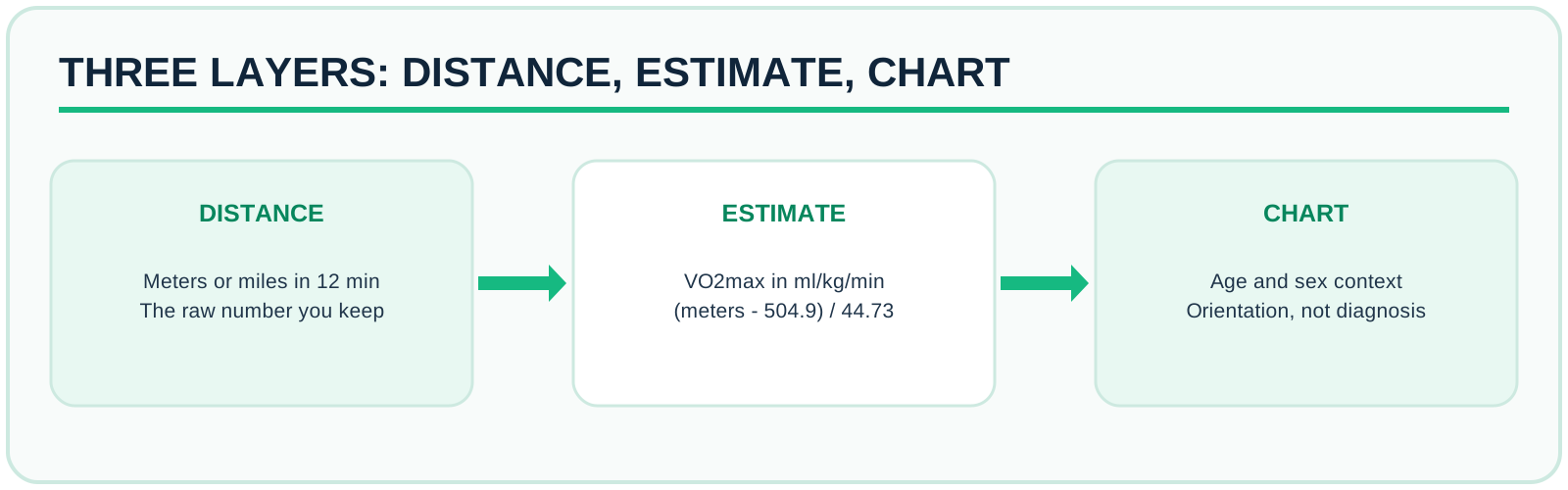
| The Cooper test calculator converts the distance you ran in 12 minutes into an estimated VO2max with the formula (meters - 504.9) / 44.73. Enter meters or miles, keep the original distance, and use age and sex only for context against a cited norm chart. The result is in ml/kg/min and is not a direct lab measurement. |
This tool answers the search for a Cooper test calculator: a fast VO2max estimate once you have finished the run. If you still need to know how to warm up, pace the 12 minutes or count laps, read the full Cooper test guide.
The split is deliberate. The guide explains how to run the test; this page calculates and interprets the number.
Cooper test calculator
Enter the total distance you covered in 12 minutes.
Field estimate. It is not a direct gas-analysis measurement and does not replace a medical evaluation.
How to use the Cooper test calculator
- Run the Cooper test for 12 minutes on a measured surface, such as a 400 m track.
- Add your full laps and the extra distance on the last lap.
- Pick meters or miles and enter the total, without rounding.
- Add age and sex only if you want a rough reference.
- Press calculate and save both the distance and the estimated VO2max.
Distance is the only input the equation needs. Age and sex do not change it; they are used afterwards to compare with a reference population and never change the numeric VO2max.
Cooper test VO2max formula
| Estimated VO2max (ml/kg/min) = (distance in meters - 504.9) / 44.73 |
Example: if you cover 2,500 meters (1.55 miles), the result is (2,500 - 504.9) / 44.73, about 44.6 ml/kg/min. The unit expresses milliliters of oxygen per kilogram of body mass per minute. One decimal is enough: the protocol already carries field error, so 44.60 is not more exact than 44.6.
Distance to VO2max table (meters and miles)
| Meters | Miles | Estimated VO2max |
|---|---|---|
| 1,400 m | 0.87 mi | 20.0 |
| 1,609 m | 1.00 mi | 24.7 |
| 1,800 m | 1.12 mi | 29.0 |
| 2,000 m | 1.24 mi | 33.4 |
| 2,414 m | 1.50 mi | 42.7 |
| 2,600 m | 1.62 mi | 46.8 |
| 2,800 m | 1.74 mi | 51.3 |
| 3,200 m | 1.99 mi | 60.3 |
The table uses the same equation and is a quick sanity check on the order of magnitude. It is not a health chart or an age classification.
Value, norm chart and official requirement
- Value: the distance and estimated VO2max you obtained.
- Norm chart: a comparison with a defined population by age, sex or other trait.
- Official requirement: a minimum mark set by a specific agency, school or exam.
A norm chart describes how results were distributed in a sample; it does not say what you should run. A police, military or school standard is an administrative rule and can differ between agencies, so check the current one that applies to you.
How to read Cooper test norms
- The exact age range of the sample.
- The sex used in the reference.
- The 12-minute protocol and surface.
- The population: general, athletes, students, military or professionals.
- The date and source of the chart.
Labels such as excellent, average or poor only mean something inside that frame. Two charts can label the same distance differently because they came from different populations. Our Cooper test norms chart in meters and miles cites its source and keeps the raw distance visible.
Cooper test for women
Women use the same 12-minute protocol and the same distance equation to estimate VO2max; there is no need to subtract meters or change the formula by sex. The difference appears when you interpret the result with population norms, which should be separate by sex and age and cite their origin. A later study examined the test's validity in female university students, but one sample does not represent every age or training level.
What an estimated VO2max really means
VO2max is the maximum oxygen uptake during incremental effort. In a lab it is measured with respiratory gas analysis; the Cooper test predicts it from running performance using a statistical relationship.
- Useful for a starting point in people suited to maximal running.
- Useful for comparing repeated tests under the same conditions.
- Useful for orienting aerobic training goals.
- Not a diagnosis of cardiovascular or respiratory disease.
- Not clearance for intense exercise or a replacement for a clinical test.
- Not comparable across different protocols, such as the 1.5-mile run.
Why your distance can change without your fitness changing
- Wind, temperature and humidity.
- Surface and curve radius.
- Shoes.
- Pacing experience.
- Fatigue from previous days, sleep, hydration or recent illness.
- Motivation and whether others are running.
- Lap-counting errors or an unmarked last fraction.
A drop of 80 meters on a hot day does not prove a loss of aerobic fitness on its own. Log the conditions with every test.
Worked example
A 32-year-old athlete covers 2,360 meters (1.47 miles). The estimate is:
| (2,360 - 504.9) / 44.73 = 41.5 ml/kg/min |
Eight weeks later she runs 2,480 meters in similar conditions: 120 meters more (5.1 %), an estimated 44.2 ml/kg/min. The training decision rests on that trend and the rest of the program, not on a jump between categories.
Common calculator mistakes
- Entering miles in a meters field, or kilometers instead of meters.
- Typing only laps and forgetting the last fraction.
- Mixing the 12-minute distance with a 1.5-mile time.
- Showing too many decimals.
- Treating an estimate as a direct measurement.
- Picking an age chart without checking its population and source.
- Changing the formula for women instead of changing only the norm chart.
- Saving the category and losing the original distance.
Cooper test calculator FAQ
What do I enter in the Cooper test calculator?
The total distance you covered in 12 minutes, in meters or miles. Age and sex are optional and only add context from a norm chart.
How do I convert miles to meters for the Cooper test?
Multiply miles by 1,609.34. For example, 1.5 miles is about 2,414 m. The calculator can take miles directly and still shows the converted meters.
Does the formula change for women?
No. The distance-based equation is the same. Only the norm chart used for context changes with age and sex.
Can I use a 1.5-mile run time instead?
Not in this calculator, which is built for the 12-minute distance. For a timed 1.5-mile run, the Cooper Institute equation is VO2max = 483 / time in minutes + 3.5; 12:00 gives about 43.8 ml/kg/min.
Why does another Cooper test calculator give a different result?
It may use a different equation, round differently or apply another norm chart. Check the formula, the unit and the source of the chart.
What is a good VO2max from the Cooper test?
It depends on age, sex, population and goal, and there is no universal threshold. For tracking, compare first with your own standardized tests.
How often should I repeat the test?
Every six to twelve weeks is usually enough in a general program, respecting the person's load and recovery.
Conclusion
The calculator turns distance into an understandable estimate, but the best practice is to keep the original number and be clear about the limits. If you track assessments for several clients, see how online personal training works with FitConnect Pro, or compare the shuttle format in the PACER test guide.
Sources and editorial note
- Cooper KH. A means of assessing maximal oxygen intake. JAMA, 1968.
- Cooper Institute: 50 Years of the Cooper 12-Minute Run.
- Validity of Cooper's 12-min run test in female university students.
- ACSM's Guidelines for Exercise Testing and Prescription, 12th edition.
General information. The tool gives a field estimate and does not replace a direct VO2max measurement or a medical evaluation.